Dubai blockchain events: which summits define the UAE tech hub?
- Dubai blockchain events are no longer trying to prove the city belongs on the crypto map.
- That argument is over.
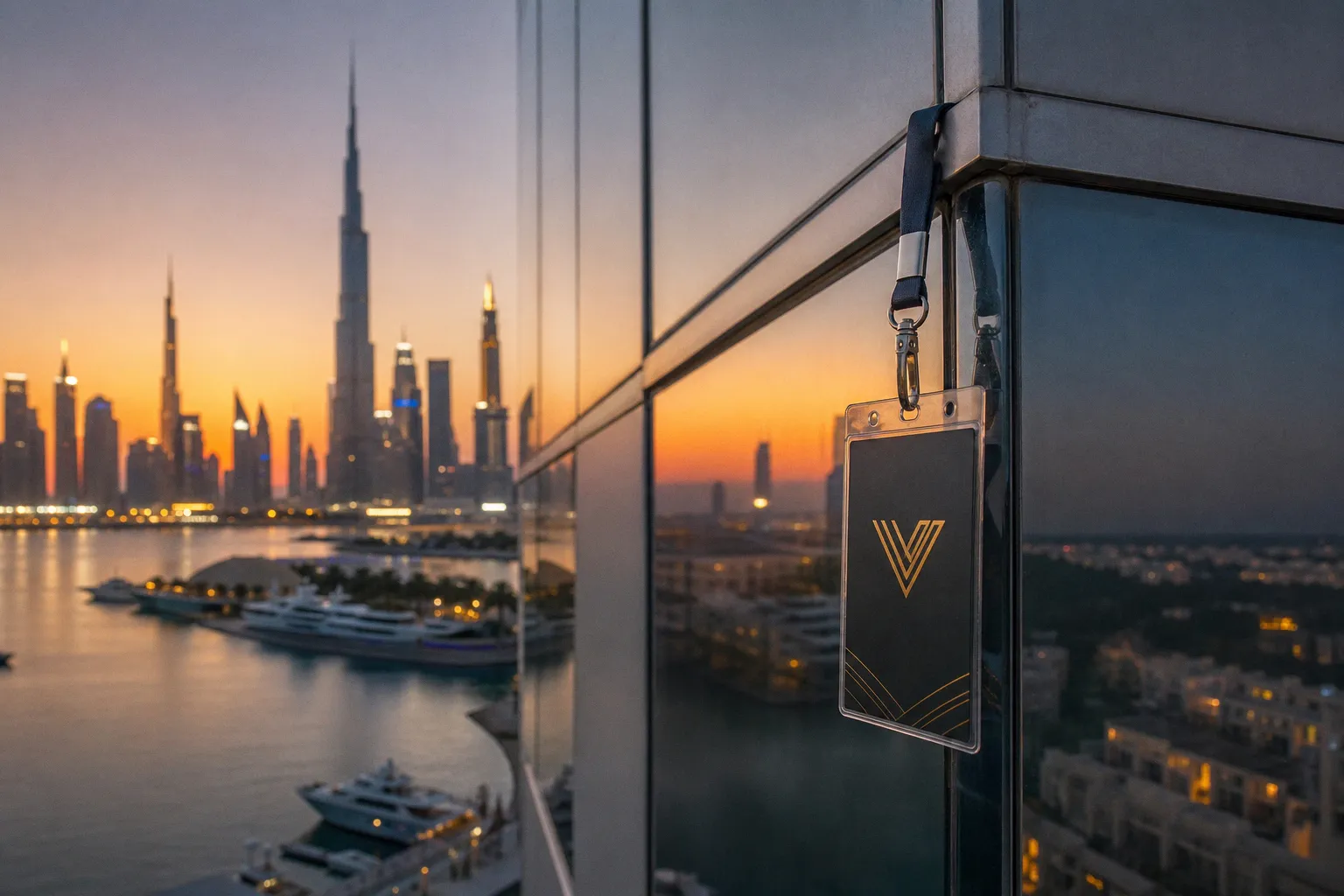
In 2024 alone, TOKEN2049 Dubai pulled in roughly 10,000 attendees at Madinat Jumeirah despite extreme weather, while Blockchain Life prepared for another 10,000-person edition at Festival Arena. Add Future Blockchain Summit’s 150-plus speakers and 200-plus exhibitors, and the scale becomes hard to dismiss.
The more useful question is which rooms actually matter.
Because a “Dubai crypto conference schedule” can look deceptively simple from a distance: book a badge, land at DXB, collect tote bags, survive a few panels, shake hands with someone wearing a protocol-branded polo. On the ground, it is messier — and more valuable. Each summit has developed its own hallway track, its own investor density, its own tolerance for hype, and its own version of what counts as alpha.
Dubai’s edge is not that every event is brilliant. Plenty are noisy. It is that the city has built enough recurring gravitational pull that founders, liquidity providers, regulators, infrastructure teams, market makers, and serious allocators keep crossing paths in the same few weeks.
How Dubai became a real Web3 meeting point
The UAE did not become a crypto hub just by installing LED screens in hotel ballrooms and calling everything “the future.” The more durable shift came from consistency.
Dubai has hosted recurring global events including Blockchain Life, TOKEN2049, Future Blockchain Summit, World Blockchain Summit, and Global Blockchain Show. That repetition matters. A one-off blockchain expo can generate photos. A recurring conference creates a calendar, and a calendar creates behavior: teams time announcements around it, funds plan side meetings around it, and founders decide it is worth flying in because the people they need will probably be there too.
The April 2024 TOKEN2049 debut in Dubai was the clearest proof of that momentum. Weather disruption did not stop roughly 10,000 delegates from showing up. That is not merely a resilience story. It showed that Dubai had become a destination strong enough to hold attention even when logistics went sideways.
There is also a practical advantage that attendees often underestimate before arriving: Dubai compresses the event geography. Major venues, hotels, investor dinners, satellite meetups, and private suites are often close enough that the real conference spills well beyond the official badge perimeter. A panel discussion Web3 audience at 3 p.m. can become a founder dinner, a market-maker conversation, and a product demo before midnight without anyone crossing half a city.
That density changes the value of attendance.
In Dubai, the stage tells you what the industry wants to say. The hallway track tells you what it is actually funding.
The vibe shift over the last cycle has been noticeable. Earlier gatherings carried more broad, breathless talk about “mass adoption.” The conversations now tend to get operational fast: licensing pathways, custody architecture, token distribution, compliance costs, stablecoin rails, and whether a project has users beyond its community Discord.
One founder put it bluntly between meetings: “Nobody asks only about the deck anymore. They ask who clears the flows, who holds the assets, and where the users are coming from.” That is a healthier question set, even if it is less flattering to projects built around a slick launch trailer.
Blockchain Life Dubai: the broad-market pressure gauge
Blockchain Life Dubai has become one of the city’s most visible crypto gatherings precisely because it is built for scale. Its 13th edition, scheduled for October 22–23, 2024 at Festival Arena, expected 10,000 attendees from more than 120 countries.
That international mix is the point.
Blockchain Life is not narrowly a developer workshop, not exclusively an institutional summit, and not a closed-door capital-markets event. It brings together traders, exchange representatives, miners, founders, affiliates, service providers, investors, and people looking for their next opportunity in the market. For better and worse, it reflects crypto’s full stack of ambitions.
The upside: you can get a fast read on market appetite. If the floor is packed with infrastructure providers, custody firms, and compliance teams, that says something. If every second conversation is about token launches, AI narratives, or meme liquidity, that says something too. Blockchain Life has always been a useful thermometer because it does not filter out the retail-facing side of the industry.
The downside is obvious: volume creates noise. A 10,000-person event is not automatically 10,000 relevant conversations. You need a thesis before you walk in.
For a founder raising capital, Blockchain Life can work well for expanding the top of the funnel — especially if the project has a clear narrative, visible traction, and a team ready to take a hundred short conversations without losing the plot. For exchanges, trading desks, and growth-focused platforms, the audience is often commercially attractive. For a deeply technical protocol team seeking a dozen high-conviction engineers, the signal may be more scattered.
The best move is to treat the official program as a routing system, not the whole product. Identify the speakers and companies that overlap with your goals, then build around them: side meetings before doors open, a coffee slot between sessions, dinner after the expo floor closes.
What Blockchain Life is best for
- Market sensing: The event’s broad delegate base makes it useful for reading which narratives have genuine circulation beyond crypto Twitter.
- International deal flow: Its 120-plus-country representation gives teams access to markets and distribution partners they may not reach through a Europe- or US-centric circuit.
- Commercial introductions: Exchanges, service providers, affiliate networks, and trading-oriented operators tend to be easier to find here than at a purely institutional forum.
- Fast visibility: A project with a sharp product demo and disciplined messaging can create a lot of first-touch conversations in two days.
The mistake is arriving with an open calendar and a vague hope that “networking happens.” Networking events Dubai blockchain people talk about most are rarely random. They are pre-planned clusters of people who already know why they should meet.
TOKEN2049 Dubai: where the global crypto circuit converges
TOKEN2049 is a different animal.
Its inaugural Dubai edition took place on April 18–19, 2024 at Madinat Jumeirah, drawing about 10,000 attendees. The crowd size overlapped with Blockchain Life, but the social wiring was distinct: more globally mobile founders, more fund principals, more ecosystem executives, more teams using the conference week to announce partnerships or quietly test whether a new narrative has legs.
The event’s value is partly in its ability to pull people out of their usual regional loops. A team based in Singapore, a European fund, a UAE market participant, and a protocol founder from the United States can all end up in the same conversation within an hour. That is the real product.
TOKEN2049 week also tends to create a sprawling satellite economy: investor breakfasts, protocol dinners, side stages, product launches, and private events that range from useful to aggressively overbooked. You can waste a day chasing guest lists. You can also leave with three conversations that reset your next quarter. Both outcomes are common.
A builder I spoke with during the Dubai run described the difference well: “At a normal event, you network for leads. Here, you network for context.” Exactly. The question is often not “Will this person invest?” It is “What are they seeing across their portfolio, region, user base, or liquidity network that I cannot see from my desk?”
That makes TOKEN2049 particularly useful for teams operating at a strategic inflection point: preparing a launch, entering new markets, considering a token event, looking for exchange relationships, or trying to understand where capital is becoming more selective.
| Parameter | Blockchain Life Dubai | TOKEN2049 Dubai |
|---|---|---|
| Core advantage | Broad international market access | High-density global crypto decision-makers |
| Best for | Commercial partnerships, visibility, market temperature | Strategic context, capital conversations, ecosystem positioning |
| Typical floor energy | Fast, broad, opportunity-driven | More curated, more narrative-sensitive |
| Networking approach | Volume plus disciplined follow-up | Targeted meetings plus selective side events |
| Common trap | Treating every badge scan as a lead | Chasing exclusive events instead of useful conversations |
TOKEN2049’s arrival also gave Dubai something important: a flagship event with instant global recognition. That does not make it the only meaningful gathering in the city — it absolutely is not — but it raises the baseline for everyone around it. Once that many international operators build Dubai into their annual travel pattern, the surrounding ecosystem benefits.
Future Blockchain Summit is where enterprise meets the crypto room
Future Blockchain Summit, held from October 13–16, 2024 at Dubai Harbour, sits in a different lane. With more than 150 speakers and 200-plus exhibitors, it is designed to be a larger digital-transformation platform, not simply a token-market congregation.
That distinction is useful.
If Blockchain Life is a pressure gauge for the wider crypto economy and TOKEN2049 is a global crossroads for the industry’s most mobile players, Future Blockchain Summit is where blockchain gets placed next to government innovation, enterprise adoption, fintech infrastructure, AI, and digital transformation.
This is not always the sexiest room in the sense crypto people mean when they say “alpha.” You will hear more enterprise vocabulary. You will encounter more exhibitors selling systems rather than stories. Some panels will inevitably use the phrase “Web3 journey” with a straight face. Conference life is cruel that way.
But for teams working on B2B infrastructure, identity, supply-chain applications, asset tokenization, compliance tooling, or government-facing systems, that broader framing can be an advantage. The conversations are less likely to revolve around the next short-term trade and more likely to focus on procurement cycles, deployment risk, integration, and regulatory expectations.
That is a slower clock. It is also where some durable business gets done.
A crowded crypto floor can tell you what is trending. An enterprise-heavy room can tell you what someone might still be paying for two years from now.
Future Blockchain Summit is especially useful for founders who need to translate blockchain-native language into business outcomes without flattening the product into a generic “innovation solution.” The good teams do not pretend decentralization is magic. They explain which bottleneck it removes, who owns the implementation, and what changes if the pilot scales.
VARA’s presence changes the tone of the room
Dubai’s Virtual Assets Regulatory Authority, VARA, is a frequent participant and keynote presence at major UAE events. That role matters far beyond the keynote stage.
Regulation is often presented at crypto conferences as a necessary interruption: the serious person in the room who arrives after the tokenomics panel to remind everyone paperwork exists. In Dubai, the regulatory conversation is more central to the event architecture. It shapes who attends, what businesses can credibly discuss, and how international firms assess the UAE as a base.
The World Blockchain Summit’s 29th global edition in Dubai in April 2024 put the UAE regulatory landscape and VARA compliance at the center of its program. That is not accidental. A city positioning itself as a long-term virtual-asset hub needs more than founder energy and capital. It needs a workable answer to the question every serious company eventually asks: “Can we operate here with clarity?”
No conference can answer that question for a company. A panel is not legal advice, and a regulator appearance does not turn a business model into a compliant one. Still, direct regulatory participation changes the quality of conversations. It forces founders and service providers to get specific about licensing, governance, custody, promotion, market conduct, and the practical boundaries of their operations.
This is where Dubai has gained an edge over event hubs that offer plenty of energy but less institutional legibility. The city’s conferences are increasingly places where crypto-native teams meet the people who think in frameworks, permissions, and long-term operating risk.
That can feel like friction if you came for pure moon-talk. It is more useful if you came to build.
The smaller events are often where the useful work happens
The conference headline is rarely the entire story.
Global Blockchain Show, scheduled for December 12–13, 2024 at Grand Hyatt Dubai, illustrates the point. Its focus on the wider Web3 ecosystem and digital transformation makes it part of the city’s year-round event rhythm rather than a one-week spectacle. World Blockchain Summit serves a similar role, connecting the sector to regional policy and business conversations.
Then there are the less visible gatherings: founder breakfasts, investor office hours, developer workshops, protocol meetups, exchange dinners, and private roundtables. The quality varies wildly. Some are thinly disguised lead-generation exercises. Others are the reason people return.
The filtering rule is simple: prioritize events with a defined participant logic.
A good side event tells you who it is for. A developer workshop names the technical problem. A roundtable states the market or regulatory question. A dinner has a host with a credible reason for putting those people together. If the invitation only promises “premium networking with Web3 leaders,” assume the guest list may be doing the heavy lifting.
For builders, especially those coming to an Ethereum hackathon or a product-focused developer gathering, the most useful encounters often happen away from the branded main stage. Technical teams are easier to evaluate when they are explaining trade-offs at a whiteboard than when they are delivering a five-minute pitch under colored lights.
Here is the field approach that consistently works:
1. Choose one primary objective. Fundraising, partnerships, recruitment, regional expansion, media visibility, and customer discovery are different missions. Do not pretend one badge solves all of them.
2. Build a 15-person target map before landing. Not 150. Fifteen people or teams where a conversation could change something concrete.
3. Leave room for the unplanned meeting. A calendar packed in five-minute increments kills the hallway track. The best conversation often begins because someone is early, late, or hiding near the coffee.
4. Use the event floor for discovery, not closure. First meetings at big conferences are usually about qualifying fit. Get the next call booked before the noise resumes.
5. Do the follow-up while the week is still warm. By the time everyone flies home, inboxes fill and memory turns into a pile of lanyards.
What to watch in the next Dubai cycle
The 2025 dates for TOKEN2049 Dubai had not been officially confirmed in the available event information, and exact ticket pricing across future editions of the major summits also remained unavailable. That uncertainty is normal this far out; the bigger pattern is not.
Dubai is likely to remain a major node for Web3 summits in the UAE because the underlying event machine is already in place: international accessibility, a dense hospitality infrastructure, a strong appetite for technology branding, and a regulatory presence that keeps serious operators in the conversation.
The dominant narrative emerging from Dubai’s conference floor is not that crypto has become boringly institutional. It has not. The city still has plenty of spectacle, questionable token launches, and enough sponsored cocktails to make everyone briefly overestimate their deal flow.
But the center of gravity is moving.
Founders are being asked tougher questions. Infrastructure providers are getting more airtime. Regulatory clarity is not treated as an afterthought. And the strongest events are separating themselves not by how loudly they promise the future, but by whether the right people keep returning to do business in the present.
Dubai’s blockchain event calendar is worth tracking because it is not just a collection of conferences. It is a live negotiation between global crypto ambition and the operational reality of building a company. If you can read that room — the panels, the side events, the investor hesitations, the VARA conversations, the hallway-track whispers — you leave with something better than a stack of business cards.
You leave knowing where the market is actually trying to go.