Dubai Crypto Conference 2025: Event Schedule and Entry Steps
Capital allocators spent the second quarter of 2025 treating Dubai as a regulated on-ramp for crypto exposure, and the on-the-ground artifact of that posture was Crypto Expo Dubai 2025, a two-day…
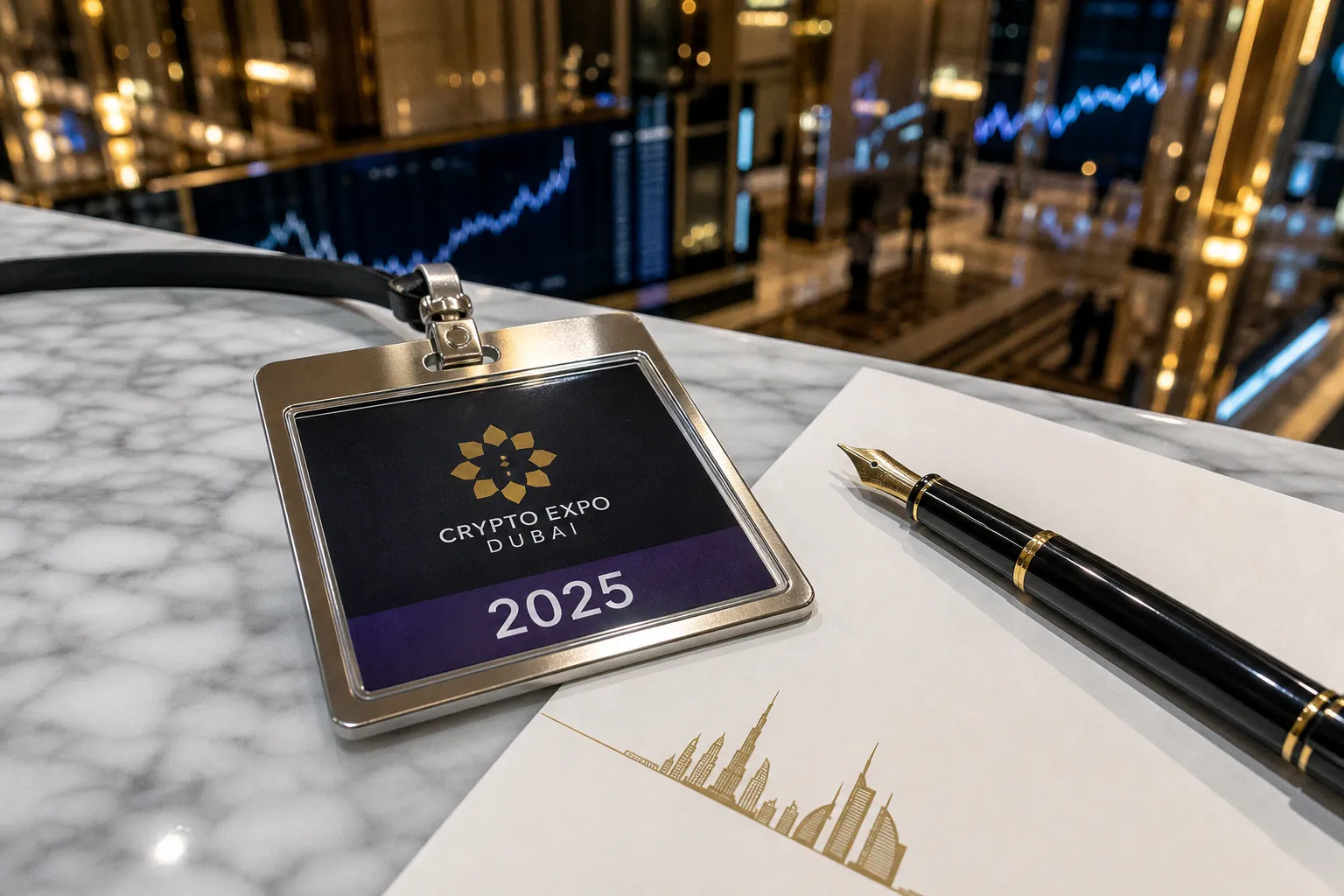
Capital allocators spent the second quarter of 2025 treating Dubai as a regulated on-ramp for crypto exposure, and the on-the-ground artifact of that posture was Crypto Expo Dubai 2025, a two-day trade-only gathering held at Za'abeel Hall 6 of the Dubai World Trade Centre on 21–22 May 2025. Public opening hours ran 10:00 to 18:00 on both days, the exhibition floor hosted more than 80 cryptocurrency brands and companies, and the conference program carried 60+ speakers and industry experts, per DWTC's own program description. The event was structured from inception around a trade-only classification — and that structural choice, more than any keynote or panel, is what makes the entry mechanics worth dissecting in detail.
This matters because "Dubai Crypto Conference 2025" — as a search term — does not correspond to a single registered event name. It is shorthand for a cluster of UAE-hosted Web3 summits whose pass logic, refund policies, and visa posture diverge sharply from one organizer to the next. The following is a tactical breakdown of Crypto Expo Dubai 2025 specifically, drawn from organizer and venue filings, plus the structural playbook that any institutional attendee should apply to similar UAE crypto summits on the broader calendar.
Crypto Expo Dubai 2025: Venue and Event Scope
The Dubai World Trade Centre (DWTC) listed the 2025 edition as a trade-only event, classified under its Za'abeel Hall 6 exhibition footprint. Trade-only is the DWTC's standard venue designation for B2B-facing exhibitions — it gates the general public at the door and lets the organizer run a floor populated by exhibitors expecting qualified buyer traffic rather than walk-in retail visitors. For an institutional delegate evaluating where to deploy capital in the second quarter of 2025, the trade-only framing is itself a filtering signal — it indicates the venue expects a counterparty mix skewed toward professional and institutional attendees rather than the general public, and that the on-site population is being curated against that baseline rather than built from open ticketing.
That classification translated into concrete scale: more than 80 cryptocurrency brands and companies in the exhibition component and 60+ speakers and industry experts in the conference program, according to DWTC's program description. Whether those headline numbers translate into qualified meetings or into a marketing-heavy exhibition is a separate question, and one that depends entirely on which pass tier the attendee carries and which side of the rope they spend their day on. The honest read is that scale on a Dubai trade floor is a function of pre-filtered counterparty quality, not raw footfall, and that distinction is the first thing a fund's travel desk should price into the trip budget.
Trade-only on a DWTC floor is not a marketing label — it is a venue classification that gates public access and tells institutional attendees the room is set up for buyer-seller conversations, not retail spectacle.
Trade-Only Dynamics: Exhibition and Conference Highlights
The two-day split between exhibition floor and conference program is the standard MICE architecture, but in a UAE crypto context it functions as a capital-allocation map. The exhibition component — the 80+ brand footprint — is where project founders compete for the finite attention of seed and Series A allocators who have flown in for the conference program in the same hall. The conference programming, with its 60+ speaker roster, is the legitimization layer: panels and keynotes do not move capital directly, but they compress trust signals that would otherwise require months of due-diligence calls. The two are not substitutes; they are complementary, and an attendee who treats them as either-or will leave Dubai with the wrong half of the picture.
For attendees optimizing around the 10:00–18:00 window on each of the two days, the trade-off is brutal and familiar: keynote attendance trades off against booth-floor density, and the deepest institutional conversations typically occur in the off-program hours. Sophisticated attendees pre-book side meetings at adjacent DWTC facilities or DIFC-district hotels precisely because the official agenda does not allocate enough white space for substantive LP conversations. The two-day format compresses everything into roughly 16 hours of formal programming, which means the meta-game is who you can pull out of that window into a private room before the closing bell at 18:00 on 22 May.
A second dynamic worth pricing in is the speaker-to-exhibitor ratio. With 60+ speakers stacked against 80+ exhibiting brands, the conference component is denser in named individuals than the exhibition component is in booths, but the exhibition carries the higher density of working capital on the floor. Funds that need to be seen at the conference program for relationship optics but actually want to source deals should staff the conference hall thinly and the exhibition floor heavily; the inverse posture — sending senior people to the conference and juniors to the booths — is the standard rookie allocation and produces the standard rookie outcome.
The technical content tracks that surfaced at Crypto Expo Dubai 2025 sat within the broader Web3 integration stack that the regional developer community is operationalizing across the DIFC and DMCC free zones. Practitioners building institutional-grade on-chain infrastructure have begun publishing practitioner-grade walkthroughs of the integration mechanics — a useful practical reference for any developer attending UAE crypto summits in the next cycle is blockchain API integration: a practical guide for Web3 devs, which covers the exact layer where conference-level discourse meets production-grade engineering. That bridge between keynote narrative and shipped code is the gap most UAE events still leave open, and it is where institutional due-diligence teams are increasingly focusing their off-floor homework.
Registration Protocols and Entry Requirements
The organizer's FAQ locked the entry perimeter with three structural rules that institutional attendees should treat as non-negotiable compliance constraints rather than logistics. First, all passes were named — tied to a verified registrant identity and not transferable to another person under any circumstance. Second, the minimum registration and entry age was set at 18. Third, no refunds were permitted under the event's published terms and conditions. Each of these rules individually looks innocuous; in combination, they form a liability perimeter that treasury desks routinely underestimate.
The named-pass rule has cascading implications for travel and finance operations. If a fund's authorized signatory registers a junior analyst and that analyst is later reallocated to a competing event, a closing transaction, or a regulatory matter, the pass cannot be reassigned, resold, or gifted — it becomes a sunk cost. The non-refund clause extends that sunk-cost risk to registration fees paid before visa approval, which is a meaningful exposure for delegates traveling from jurisdictions where UAE visa processing can take weeks. Sophisticated desks hedge this by registering the most senior attendee first and only adding junior staff once the visa confirmation email is in hand; that sequencing avoids the trap of paying a non-refundable fee for a delegate who never receives travel clearance.
The 18+ rule is the cleanest of the three because it surfaces in advance through the standard registration form, but it does intersect with a real edge case. Funds occasionally register analysts under the assumed authority of a senior partner without confirming the analyst's actual age or document status, and the named-pass mechanic is precisely where that gap surfaces — at the badge-collection desk, with the analyst physically present and unable to claim the badge. The fix is operational rather than contractual: every named registration should be cross-checked against a verified ID document before the registration fee is committed.
The on-site badge collection procedure, required identification documents, and registration-desk location for the 2025 edition could not be confirmed from the available official materials at the time of writing. Institutional attendees should plan for a standard DWTC convention-hall badge collection with passport-grade ID verification, but they should confirm those mechanics directly with the organizer in advance of travel rather than relying on the published FAQ as the final word. The general rule at DWTC is that trade-only events enforce a tighter ID-matching protocol than consumer-facing conferences, and attendees should budget arrival time accordingly.
A named, non-transferable, non-refundable pass in a foreign jurisdiction is not a ticket — it is a contingent liability, and treasury teams that do not price it that way before booking are absorbing unmanaged risk.
Navigating Travel and Visa Logistics for UAE Summits
The organizer's FAQ drew a hard line on visa support: it does not provide visa assistance, and delegates are directed to check travel-document requirements with their local government. The FAQ added that the registration-approval confirmation email would generally suffice for visa-related purposes. That phrasing — "generally" — is doing a lot of load-bearing work, and it is exactly where institutional travel desks get caught when they assume organizer language equates to consular policy.
For UAE crypto summits, the practical visa playbook splits into three tiers. Delegates from visa-waiver nationalities — most GCC residents, EU passport holders, and a long list of additional jurisdictions under the standard UAE visa-waiver program — require no pre-approval and can rely on the registration email as supporting documentation only if questioned at the border. Delegates from nationalities requiring UAE pre-arranged visas must initiate the visa process before booking non-refundable passes, because the registration email is not a substitute for a visa decision and the organizer's "general sufficiency" language will not override a consular officer's discretion. Delegates from high-friction jurisdictions — those that historically require UAE sponsor letters, attested invitations, or employer-side documentation — should not rely on the registration email alone and should factor in an invitation-letter workaround through a UAE-licensed sponsor or a DIFC-registered counterparty before locking the trip. Pricing the wrong tier into the wrong delegate is a recurring line-item loss for funds that treat UAE crypto summits as standard conference travel.
The operational point is that visa and entry logistics for UAE crypto summits are now a meaningful input into trip planning rather than a downstream detail. The absence of organizer-led visa support tells institutional travel desks that the event assumes delegates handle their own consular paperwork. That assumption is reasonable for visa-waiver delegates, but should not be treated as a substitute for visa processing for delegates from nationalities that require pre-approval — and it definitely should not be conflated with the marketing claim that "Dubai handles visas at the door." It does not, and treating that assumption as fact has stranded more than one fund's analyst at the airport hotel while the conference floor ran without them.
One more operational wrinkle worth flagging: the registration-approval email and the visa-supporting email may not be the same document, and the timing between them can run several days even for visa-waiver jurisdictions that need to verify the registration with the organizer. Funds that need all named passes confirmed in advance of the travel desk's hotel block should add a buffer day between the expected approval email and the flight booking, because rebooking fees on Dubai-bound flights during the May event window tend to dwarf the cost of the buffer day.
Understanding Ticket Categories and Non-Transferable Policies
The official event site presented four access categories for Crypto Expo Dubai 2025: Visitor, Standard, Delegate, and VIP. A critical caveat: the currently indexed official ticket page on the Crypto Expo website is promoting a later edition, so any ticket prices displayed there should not be treated as 2025 prices. The 2025 pricing for each tier could not be reliably established from the available official materials at the time of writing, and institutional travel desks that lock budgets off an undated site are pricing a moving target rather than the actual event.
What can be established is the structural overlay that governs every tier. The four categories are listed on the official event site as named access levels; the organizer does not publish a verified per-tier benefit matrix in publicly accessible materials, so attendees should request the current inclusions directly from the organizer before booking. The non-transferable, non-refundable policy applies across the registration framework per the published FAQ, which means that the wrong tier selection is a hard loss under any of the categories. Treasury desks should treat the tier decision as final at the moment of registration and should pre-clear the selected tier against the attendee's actual mandate before booking.
- Visitor — listed as the entry-level access category on the official event site.
- Standard — listed as a step up from Visitor, with published inclusions to be confirmed with the organizer.
- Delegate — listed as a higher-tier access category, with published inclusions to be confirmed with the organizer.
- VIP — listed as the top-tier access category on the official event site.
The practical implication of this opacity is that institutional attendees cannot price the tiers against each other from public materials alone. The honest move is to request the per-tier inclusion list and the 2025 fee schedule from the organizer in writing before registration, and to treat any verbal assurance as non-binding. That documentation step is also what protects the treasury desk if post-event reconciliation surfaces a gap between what was promised and what was delivered on the floor.
Closing
Crypto Expo Dubai 2025 was a textbook example of how Dubai's MICE infrastructure operationalizes a trade-only classification for crypto events: venue-gated public access at Za'abeel Hall 6, named non-transferable passes to lock identity to badge, no organizer-led visa-support overhead, and a four-tier structure that segments the floor. None of those design choices is accidental, and each one shifts operational risk from the venue and organizer onto the attendee and the attendee's treasury.
The immediate tactical implication for institutional players is straightforward. The Dubai crypto event calendar should be modeled as a series of capital-allocation checkpoints, not as marketing conferences. The pass tier, the visa posture, the named-pass liability, and the refund wall all map directly onto fund-level exposure management. Allocators who price those mechanics in advance — by sequencing senior registrations after visa confirmation, by requesting written tier inclusions before booking, and by pre-clearing the tier decision against mandate — will treat Dubai as the regulated on-ramp it is set up to be. Those who treat it as a marketing trip will absorb the sunk cost the FAQ warned them about, and will register the next edition with better discipline.