Evaluate 6 Tokenomics Red Flags in Solana IDO Projects
The current cycle of market scrutiny on Solana IDO vesting schedules — running through 2024 and 2025 — has not slowed capital allocation into the venue; it has simply shifted the diligence burden…
The current cycle of market scrutiny on Solana IDO vesting schedules — running through 2024 and 2025 — has not slowed capital allocation into the venue; it has simply shifted the diligence burden from launchpad screening to retail participants who now underwrite tokenomics sheets that institutional desks would refuse to clear. A $4M-class IDO on a mid-cap launchpad can print a 12x multiple on Raydium within hours of listing and slide 78% within nine trading sessions, and the variable that determines which outcome materializes is the contract deployment that the majority of public market participants never audit. The institutional framework for evaluating six tokenomics red flags in Solana IDO projects has consolidated around six structural variables that predict post-launch price behavior with high reliability, and the practitioner who integrates all six into the whitelist decision consistently outperforms the practitioner who treats the whitepaper narrative as a substitute for contract forensics.
Tokenomics is the contract you sign with yourself when you whitelist an IDO. If you cannot read the vesting schedule, you are underwriting someone else's exit.
The macro implication for capital allocators evaluating Solana exposure at the fund level is that the same structural pathologies that enable insider capital flight in a single launch aggregate into systemic risk for the broader Solana DeFi liquidity stack — every IDO that dumps, decays, or quietly bleeds is a withdrawal of trust from the venue, the launchpad, and ultimately the chain, and capital that exits the ecosystem at the unlock cascade does not rotate into the next IDO, it rotates out of Solana entirely.
Allocation Architecture: Why The 25% Team Threshold Is Non-Negotiable
The single most predictive variable in any Solana IDO tokenomics sheet is the team and advisor allocation expressed as a percentage of total supply, because that figure determines the maximum theoretical sell pressure that the public market must absorb before the unlock cadence forces a repricing event. The defensible threshold, derived from comparative analysis of post-2022 Solana launches that retained at least 60% of their initial market cap over a 12-month window, sits below 20%, with anything above 25% functioning as a structural red flag that materially degrades the risk-adjusted return profile of the position.
The cause-and-effect chain is mechanical: a 30% team allocation vesting over four years releases 7.5% of total supply annually into the market through linear unlock, and when that emission is layered on top of advisor unlocks, treasury sales, and ecosystem incentive distributions, the cumulative monthly supply expansion routinely exceeds the organic demand growth that a nascent protocol can realistically attract. The result is not a single liquidation event but a persistent overhang that compresses valuation multiples and erodes the public market participant's position even when the underlying protocol performs against its operational milestones. This is why institutional diligence teams treat the team allocation as the first filter rather than the last — it is the variable that most reliably predicts whether the rest of the tokenomics sheet is being optimized for fundraising optics or for durable price discovery.
A secondary failure mode within allocation architecture is the conflation of team and advisors as a single bucket, which obscures the actual insider concentration and creates an optical illusion of compliance when the underlying structure remains exploitative. A project that discloses 15% to team and 12% to advisors has effectively disclosed 27% to insiders, with the advisor line item frequently including strategic partners, market makers, and launchpad operators whose lockups are negotiated on different contractual terms than the core team's. The audit discipline requires disaggregating every allocation line in the whitepaper against the on-chain distribution wallet, because the whitepaper narrative and the deployed contract rarely match with surgical precision.
The Cliff Question: Why Absence Of A Delay Is An Immediate Disqualifier
The cliff period — the hard delay between token generation event and the first unlock tranche for early investors, team, and advisors — is the mechanism that aligns insider incentive duration with public market participant risk exposure, and its absence is one of the most reliable leading indicators of a project structured for short-term capital extraction rather than protocol development. The defensible cliff window for Solana IDOs sits between six and twelve months, calibrated to provide enough operational runway for the team to deliver against milestones while preventing immediate post-launch liquidation that destroys the price discovery process before it stabilizes.
When a project launches with a zero-cliff structure, it is communicating in contractual terms that the earliest backers have no enforced holding period and can exit at any point following the TGE, which means the first wave of supply pressure hits the order book at the moment when the public market is most price-elastic and most vulnerable to cascading liquidations. The downstream effect is not merely a poor entry point for retail; it is a contamination of the launch venue's reputation, because the order flow data from a zero-cliff launch skews the venue's apparent liquidity profile and misprices subsequent launches on the same platform. This is the mechanism by which individual project tokenomics failures cascade into launchpad-level structural damage, and why platform-level due diligence now treats per-project cliff compliance as a hygiene metric rather than a discretionary consideration.
The vesting schedule that follows the cliff is the secondary variable, and the institutional standard sits between two and four years with linear monthly unlocks following the cliff expiration. Projects that front-load vesting into large quarterly tranches create predictable supply shock windows that sophisticated market participants can front-run, while projects that extend vesting beyond four years frequently signal an absence of meaningful insider commitment to near-term operational delivery. The optimal structure aligns the cliff duration with the protocol's expected product-market fit timeline, and the post-cliff vesting curve smooths supply expansion into the organic demand growth that a functioning protocol generates through fee capture, user acquisition, and partnership revenue.
Float And Supply Dynamics: The 10%–20% Circulating Window
The initial circulating supply as a percentage of total supply determines the float depth at listing, and the analytical standard for Solana IDOs places healthy launches in a 10% to 20% range — below 10% the float is artificially thin and susceptible to single-wallet manipulation, above 20% the unlock pressure in early months is sufficient to overwhelm organic demand from a nascent user base. The structural pathology of the thin-float launch is well-documented: when 8% of supply is circulating and the remaining 92% is locked across team, treasury, and ecosystem buckets, the market-clearing price for the circulating float reflects a hypothetical fully-diluted valuation that is mathematically unsustainable once any meaningful unlock tranche begins trading.
The practical failure mode is reproducible across the 2023–2024 Solana launch cohort: a project lists at an apparent $40M FDV based on a $3.2M circulating float, retail allocates on the basis of that headline valuation, and within 90 days the first unlock tranche hits the market, expanding circulating supply by 8–12 percentage points and repricing the token to reflect the new equilibrium between expanded float and stagnant demand. The position that appeared to be a 2x trade at allocation is now underwater by 30–50% on a fully-diluted basis, and the public market participant who read the headline valuation without auditing the float structure has effectively funded the exit of the previous tranche holders.
The due diligence workflow requires three concurrent data pulls: the whitepaper's stated circulating supply at TGE, the on-chain verification of that figure via the token contract's deployment transaction, and a reconciliation against the project's published tokenomics chart, which routinely overstates the circulating figure to compress the apparent unlock pressure. A project that claims 15% circulating at TGE but whose deployment contract shows 22% in the public sale bucket plus 4% in immediately-liquid ecosystem incentives has effectively disclosed 26% float, which sits at the upper boundary of the healthy range and offers no margin for execution error in the early trading window.
Concentration Risk: What Solana Explorer Reveals That The Whitepaper Conceals
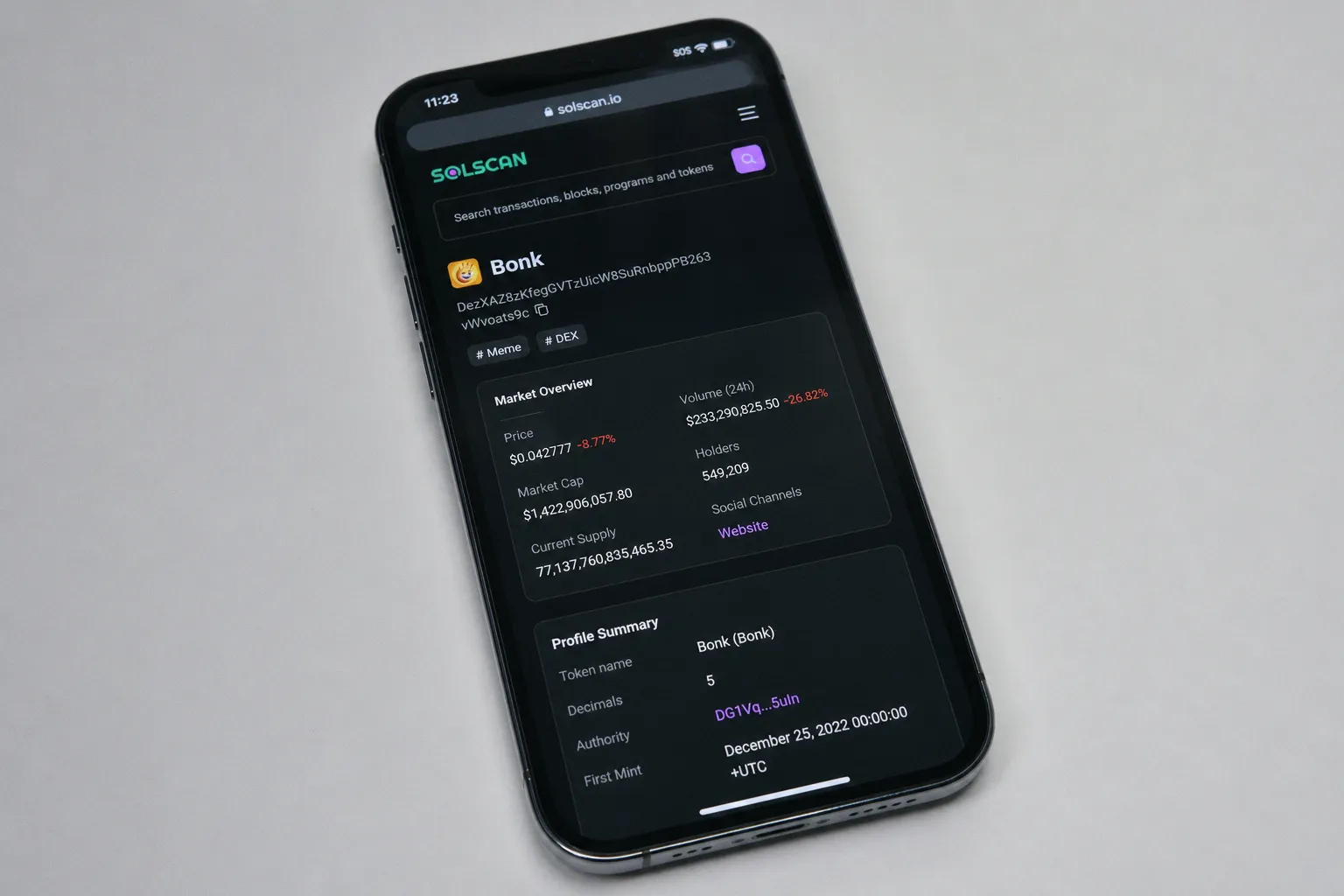
The whitepaper is a marketing instrument, and the contract deployment is the binding document — and the gap between the two is where insider concentration risk lives, detectable only through on-chain forensics against the deployed token contract via Solana Explorer or equivalent indexing infrastructure. The red flag cluster here includes single-wallet holdings exceeding 5% of total supply without a vesting contract lockup, cluster wallets that route through common funding sources and collectively exceed 15% of supply, and treasury wallets that retain discretionary authority to transfer tokens to exchanges without a published governance mechanism governing those transfers.
The verification protocol against the deployed state requires four sequential checks:
1. Identify the deployer wallet from the contract creation transaction and trace its full transfer history to identify cluster relationships with named wallets in the whitepaper's team and advisor sections.
2. Audit the top 20 token holders at TGE against the published allocation table and flag any discrepancy above 0.5 percentage points as a structural red flag warranting direct project disclosure.
3. Verify that all wallets exceeding 1% of supply have associated vesting contracts locked at the protocol level, rather than relying on the project's voluntary disclosure of lockup commitments.
4. Monitor the deployer wallet for any post-TGE transfers to centralized exchange deposit addresses, which is the leading indicator of insider distribution in advance of public unlock dates.
The analytical framework treats concentration as a probabilistic variable rather than a deterministic one: a single wallet holding 7% of supply is not an automatic disqualifier if the wallet is locked under a verifiable vesting contract with a 12-month cliff and three-year linear unlock, while a cluster of three wallets each holding 3% with no on-chain lockup represents a 9% float risk that the project has effectively concealed from the whitepaper. The discipline is not the absolute number; the discipline is the reconciliation between the disclosure and the deployed state.
The whitepaper is the pitch. The contract is the deal. Read both, and assume the contract is the binding document until proven otherwise.
Deflationary Architecture: Burn Mechanisms And Long-Term Value Retention
The absence of a clear deflationary mechanism in a project with high total supply is a structural red flag for long-term value retention, because it signals that the project's economic model relies exclusively on demand-side growth to absorb an expanding supply curve without any contractual offset on the supply side. The defensible architecture combines three elements: a transaction fee burn that scales with protocol usage, a buyback-and-burn mechanism tied to treasury revenue, and an explicit supply ceiling documented in the tokenomics sheet that establishes the long-term equilibrium between emissions and burns.
The failure mode in the Solana IDO cohort is consistent: projects launch with an emissions-heavy tokenomics model — high staking rewards, aggressive liquidity mining incentives, expansive ecosystem grants — and disclose a nominal burn mechanism buried in a sub-section of the whitepaper that activates only at usage thresholds the protocol is unlikely to reach within the vesting window. The result is a net inflationary supply curve that compounds over the unlock period, eroding per-token value even when the underlying protocol is delivering against operational milestones. Institutional diligence teams treat the absence of a contractual burn schedule as equivalent to the absence of a cliff: a structural signal that the project has not committed to a supply equilibrium and is instead relying on continued demand growth to mask an unsustainable emissions profile.
The secondary variable is the interaction between burn mechanism and governance. A burn schedule that requires governance approval to activate is functionally equivalent to no burn mechanism at all, because the political economy of token holder governance consistently favors emissions over burns in the early years of a protocol's lifecycle. The defensible architecture embeds the burn mechanism at the protocol level, with on-chain verification of burn transactions and a public dashboard showing cumulative burns against cumulative emissions, which provides the analytical foundation for projecting the long-term supply trajectory under varying demand scenarios.
Due Diligence Is Not A Tokenomics Sheet
Tokenomics audits are necessary but not sufficient, and the practitioner who treats a clean vesting schedule as a buy signal without integrating project-level operational diligence, team background verification, smart contract audit review, and competitive landscape analysis has built a position on a single-factor model that will fail in scenarios the tokenomics sheet cannot price. The analytical rigor applied to an IDO allocation mirrors the rigor required in adjacent domains of consumer financial decision-making and practical life planning — practitioners who compartmentalize crypto diligence from broader discretionary capital allocation underperform both. For those building that broader operational discipline outside the narrow crypto frame, practical life and consumer decision-making resources offer complementary reference points.
The institutional macro implication is that capital allocators who integrate tokenomics screening with operational and competitive diligence consistently outperform those who treat any single factor as dispositive, and the gap in performance widens materially in drawdown cycles when the marginal IDO's structural weaknesses compound against a contracting liquidity environment. The closing frame for institutional players evaluating Solana exposure at the fund level: a launchpad's average tokenomics quality across its last ten IDOs is a more reliable predictor of forward returns than any individual project's whitepaper, because the aggregate quality reflects the launchpad's screening discipline and its alignment with public market participants rather than with project wallets.
The Six Red Flags At A Glance
| Red Flag | Threshold | Signal | Structural Consequence |
|---|---|---|---|
| Team / Advisor Allocation | >25% of total supply | Disclosed in whitepaper allocation table | Persistent overhang from linear unlocks compressing valuation multiples |
| Cliff Period | <6 months or absent | Zero-cliff or sub-six-month delay in vesting contract | Immediate post-TGE sell pressure before price discovery stabilizes |
| Vesting Duration | <2 years post-cliff | Quarterly front-loaded tranches or short linear unlock | Predictable supply shock windows exploitable by sophisticated actors |
| Initial Circulating Supply | <10% or >20% | Disclosed float vs. contract deployment divergence | Thin-float manipulation or excess early unlock pressure |
| Insider Concentration | Single wallet >5% or cluster >15% | On-chain forensics via Solana Explorer | Hidden distribution events preceding public unlock dates |
| Deflationary Mechanism | Absent or governance-gated | No contractual burn schedule at protocol level | Net inflationary supply curve compounding against unlock cadence |
Audit the venue before you audit the project, price the structural default of the chain into every position you underwrite, and treat the tokenomics sheet as a contract rather than a narrative — because in the Solana IDO market of 2024 and 2025, the practitioner who reads the contract is the only one still holding the position at the end of the vesting window.