Kenya blockchain and crypto conference: attendee checklist
has stopped debating whether to regulate digital assets and started pricing the transaction.
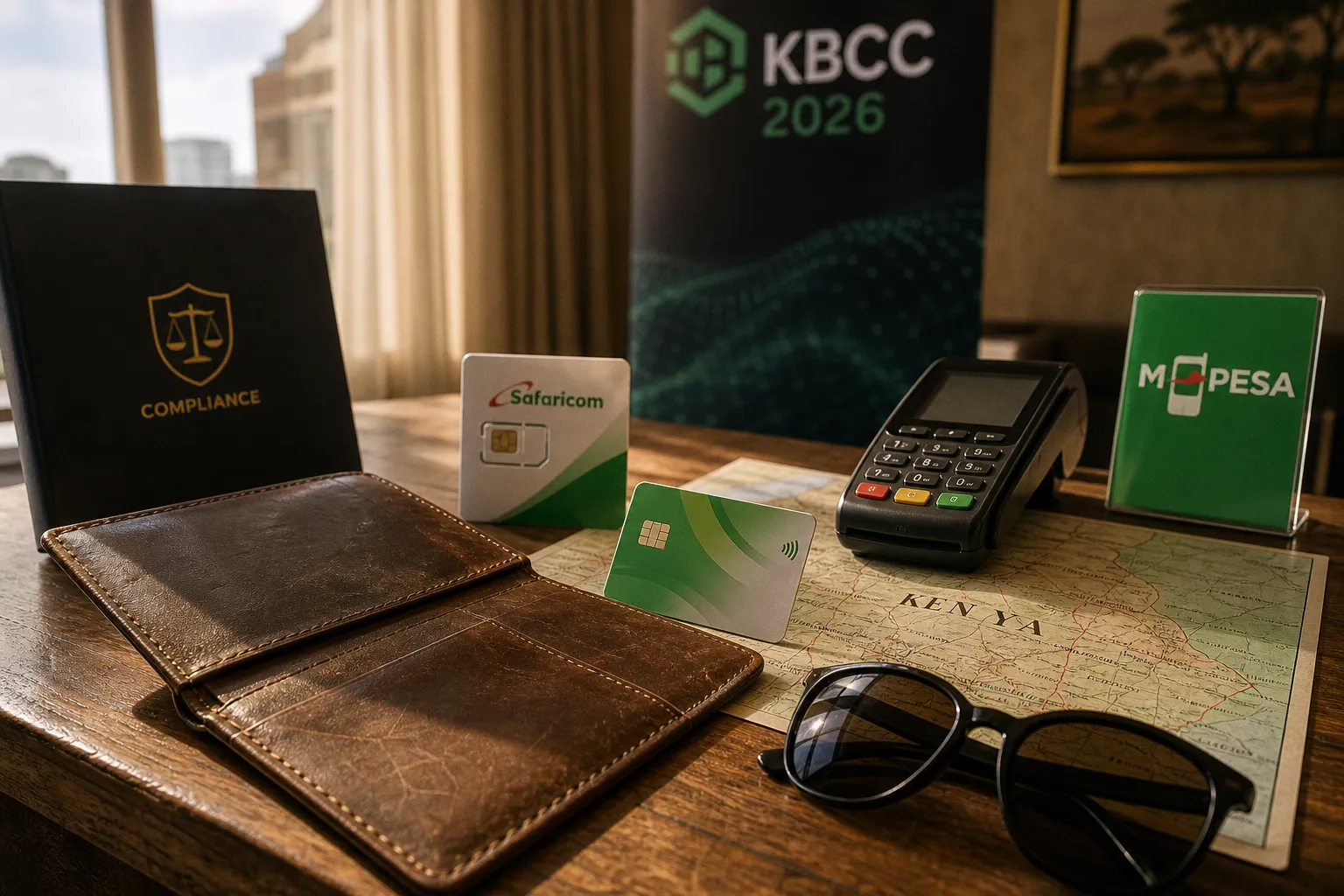
On May 14–15, 2026, the fourth edition of the Kenya Blockchain and Crypto Conference (KBCC) lands at the A.S.K Dome in Nairobi under the explicit theme "Stablecoins, Payments & the Next Phase of Africa's Digital Economy" — and the timing is not a coincidence, because the regulatory perimeter is closing faster than the conference circuit can keep up with. For institutional delegates, founders, and treasury teams flying in from offshore, the agenda is the easy part; the friction sits in the visa lane, the mobile money counter, and the Finance Bill that is already working its way through Nairobi's legislative pipeline. Anyone treating this as a regional Web3 mixer is arriving at the wrong conference.
The agenda has narrowed — and that is the point
KBCC 2026 is not a generalist Web3 gathering, and the sponsor sheet tells you why. With Kotani Pay locked in as Diamond Sponsor, the conference is effectively underwriting the rollout of dollar-pegged settlement infrastructure aimed at remittance corridors, B2B cross-border payments, and the integration of M-Pesa's agent network into programmable money stacks. The theme is not a marketing slogan; it is a procurement brief, signalling that the floor will be dominated by payment-rail operators, FX desks, and licensing advisors rather than the L1 protocol evangelists who usually rent the mic at summits of this size.
The 2026 programme is a procurement brief dressed as an agenda. Stablecoins are the rail, and Kenya intends to be the clearinghouse.
The 2025 edition set the operational baseline that institutional planning is being benchmarked against: 1,633 attendees, 70 speakers across 27 sessions, and 40 exhibitors representing 30 countries — a profile that confirms KBCC is now a working conference calibrated around payment infrastructure and licensing conversations rather than the token-launch circuit that dominates other regional events. The 2026 build is clearly designed to compound that throughput, and that compression matters. Panels will not be interested in token launches or yield-farm retrofits; they will be interrogating treasury management, FX hedging against the Kenyan shilling, the cost of capital for stablecoin issuance in a jurisdiction where the central bank has signalled that sandboxes are not infinite, and the unit economics of routing diaspora remittance volume through licensed onshore venues. For anyone still reading the African crypto market as speculative retail flow, the A.S.K Dome will correct that framing inside the first ninety minutes.
Lock down the eTA before you lock in the flight
Kenya's Electronic Travel Authorization is mandatory, and it has fully replaced the old eVisa system and any residual on-arrival visa processing. There is no fallback, and there is no consular discretion available to late applicants. The eTA is filed online through the official portal, and the platform requires submission at least three days before departure — a buffer that exists because name-match systems can flag applications for additional checks that extend approval timelines without warning.
The document set is short but unforgiving. You will need a passport valid for at least six months with a minimum of one blank page, a recent photograph or selfie conforming to standard biometric norms, verified contact details, a confirmed flight itinerary, and proof of accommodation in Kenya. Hotel bookings tied to a verifiable Nairobi address satisfy the requirement cleanly; a forwarded short-stay confirmation with a host who is not on the booking is a common trigger for rejection. Delegates who treat the eTA as a thirty-minute formality tend to discover, typically forty-eight hours before their flight, that the file has been pushed into a longer queue and that the conference's opening session has already begun without them. The efficient move is to file on the same day the flight is booked, screenshot the approval, and carry the printed confirmation in the same folder as the boarding pass. Treat the eTA as a critical-path workstream, not an admin chore — it is the only document between you and the dome.
M-Pesa is not optional — it is infrastructure
The single most underestimated line item in the KBCC travel sheet is the cost of standing up M-Pesa. Kenya runs on mobile money, and a foreign passport cannot be onboarded through a street agent; registration has to happen at an official Safaricom retail shop, in person, with the original passport on the counter. A physical SIM will set you back roughly 100 Kenyan shillings, an eSIM closer to 200, and the activation process — passport scan, biometric capture, PIN setup, initial float — takes the better part of an hour once queue time is included. The cost is trivial; the friction is structural.
The reason this matters for crypto delegates is not convenience; it is settlement. Vendors at and around the A.S.K Dome, hotels, ride-hail drivers, and most of the after-hours networking venues will route through M-Pesa or Lipa na M-Pesa. Anyone arriving with the assumption that a stablecoin wallet, a foreign-issued card, or USD cash will cover ground transport, dinner, and the sponsored side events will spend the first evening recalibrating — and the second morning apologising to counterparties who quoted prices in KES and never saw the payment clear. The efficient path is to land at Jomo Kenyatta International Airport, walk past the souvenir counters to a Safaricom shop in the arrivals wing, complete the KYC, fund the wallet from an ATM, and treat the airport-to-M-Pesa handoff as the real entry protocol. The conference's underlying thesis — that programmable money has to land on existing rails rather than bypass them — is visible the moment you try to pay for an Uber without a local SIM.
Read the room — and the Finance Bill
The regulatory backdrop is where institutional capital is currently mispricing East Africa, and it is the section of this brief that will move the most money. Kenya's Virtual Asset Service Providers (VASP) Bill, paired with the active Finance Bill cycle, proposes a 1.5% digital asset tax on crypto transactions — a figure that on the surface looks modest and on a volume-weighted basis is a serious piece of revenue architecture. For platforms routing flows through Nairobi, the tax is not a rounding error; it is a determinant of net margin, of fee competitiveness against regional hubs in Rwanda, Mauritius, and the UAE, and of where treasury teams will ultimately book their regional entities and their stablecoin reserves.
The 1.5% is not a tax. It is a price signal to offshore capital about where Kenya wants settlement to land.
That is the regulatory arbitrage conversation happening quietly in the corridors of KBCC 2025's successor, and it is the reason the conference has pulled a Diamond-tier sponsor out of the stablecoin-payments stack rather than out of the L1 protocol wars. The Kenyan government is signalling, through both the tax proposal and the sandbox posture, that it wants onshore settlement, not offshore routing — and the cost of that signal will be paid either by the platforms in the form of a thinner take rate or by the user in the form of a more expensive on-ramp. Delegates who read the agenda as a marketing exercise rather than a regulatory telegraph will arrive pitching liquidity bootstrapping in a room that has already moved on to licensing frameworks, capital adequacy ratios, and the operational architecture required to keep M-Pesa and a stablecoin treasury in continuous reconciliation. The serious conversations in May will not be on the main stage; they will be in the back rows, and the seats are already being reserved.
The venue is the venue — the city is the signal
The A.S.K Dome in Nairobi is a functional exhibition hall, not a destination statement, and that is precisely the point. The conference is built for throughput: keynote, panel, booth, repeat, with the networking load distributed across the dome floor and a curated side-event calendar that runs into the late evening. Dress code is business, and Nairobi's high-elevation climate tends to run cooler than the equatorial stereotype — delegates flying in from genuinely tropical postings should still pack a light layer for early mornings, air-conditioned conference halls, and the post-7pm drop in temperature. The standard Nairobi wardrobe applies: the conference badge will spend most of its life clipped to a blazer rather than a t-shirt. Pre-registration well in advance of the event is the safer route. Walk-in policies at regional summits tend to flex with fire-load compliance, venue capacity, and the organising team's ability to absorb late additions, and the closer you cut it to the doors opening, the less discretion they have to say yes.
What the venue undersells is the city's diplomatic gravity, and that is the macro read most delegates will miss. Nairobi is positioning itself as the financial and convening capital of East Africa, a role reinforced by its recent stewardship of the UN Environment Assembly, where bold global environmental commitments signalled a parallel ambition to host the world's heaviest policy conversations alongside its commercial ones. Crypto delegates who treat KBCC 2026 as a regional stop are misreading the corridor: the same diplomatic infrastructure that moves climate finance and continental trade is now being wired for programmable settlement, and the delegates on the ground in May will be the ones writing the first term sheets against that infrastructure. The A.S.K Dome is the room; Nairobi is the thesis.